



ABOUT
The JAZZ MANOUCHE
that changed my life.
IT START WITH
An Endless Passion for Music
For Discovery, for life and for people
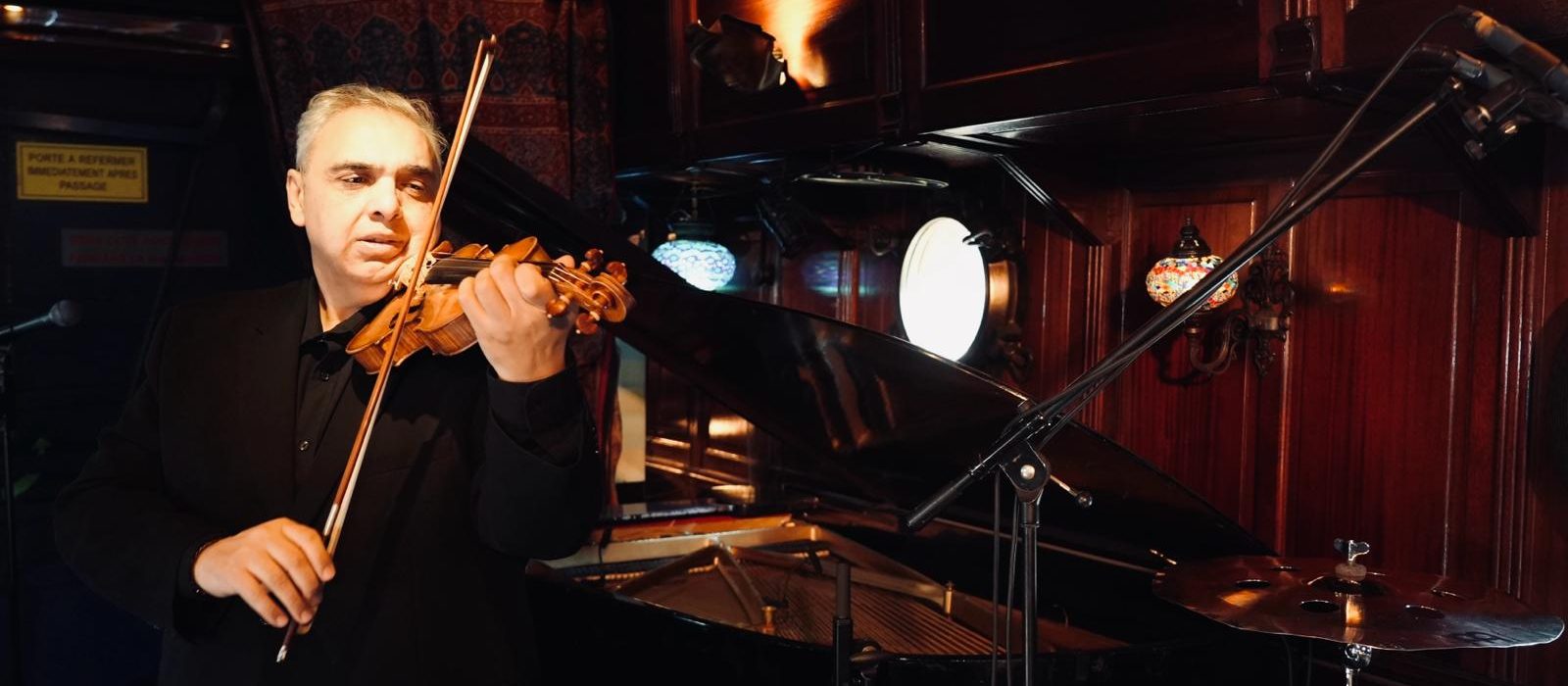
Florin Niculescu, born in Bucharest on 7 February 1967, is a Gypsy jazz violinist in the tradition of Stéphane Grappelli and Django Reinhardt.
Born in Romania into a family of Roma musicians, he studied music at the George Enescu Academy Conservatory in Bucharest.
He works regularly with the George Enescu Philharmonic Orchestra in Bucharest. He started out as a soloist with the Bucharest Conservatory Orchestra. He left the George Enescu Academy with a first prize. In 1984, he won a special mention from the jury at the Henryk Wieniawski International Competition in Ljubljana.
At the age of 24, he chose to move to France, where he first met Boulou and Elios Ferré, with whom he collaborated in the early 1990s, then Romane and Babik Reinhardt, with whom he recorded the Hot Club de France’s « New Quintette » album in 1998.
The following year he released his album Gipsy Ballads.
Subsequently, this musician, regarded as one of Stéphane Grappelli’s successors6, collaborated with Biréli Lagrène in a quintet based on the legendary Hot Club de France quintet, releasing another album in 2001.
In the 2000s, the Lagrène-Niculescu duo continued their career8, with further recordings and a world tour. Niculescu is also a member of the group Latcho Drom with Christophe Lartilleux.
Florin Niculescu has also contributed to albums by popular artists such as Henri Salvador, Patrick Bruel and Charles Aznavour.
In 2005, for the album Djangophonie, he brought together the classical string quartet Drina and the jazz trio Latcho Drom.
« I was born into a family where the violin was the king of instruments ».
« As soon as I could stand on my own two feet, I started learning to play the violin ».

STEPHANE GRAPPELLI
Passion never die. It grows
"Stay Hungry and Funny"
Gypsy jazz is a style of jazz that reflects the stylistic contributions of gypsy, gypsy and Central European (klezmer) music, as well as musette and French chanson, to jazz, which arrived in Europe from the United States in 1932. Born in France in the 1930s, its original form was characterised by a rhythm section consisting of two guitars and a double bass, a violin and the absence of percussion, brass or woodwind instruments – « jazz without drums or trumpets ».
The originators of this style, initially characterised by string instruments, were Django Reinhardt and Stéphane Grappelli, who were joined over the years by accordionists, bassists and clarinettists. The new generation of musicians has taken gypsy jazz in several directions, notably towards the jazz-rock of Boulou Ferré.